Networking
There is no special requirement on the network architecture for databases powered by Kunpeng processors. You can flexibly plan the network architecture based on the service scale and reliability requirements. In the production environment, it is recommended that the management plane, service plane, BMC plane, and replication plane be separated from each other to isolate traffic for O&M management, service access, out-of-band management, and data synchronization. This prevents different types of traffic from affecting each other and improves system security, reliability, and O&M efficiency.
The typical network plane planning is as follows:
|
Network Plane |
Function |
Recommended Bandwidth |
|---|---|---|
|
BMC plane |
Out-of-band management of servers |
1GE |
|
Management plane |
O&M management, alarm monitoring, and automatic deployment |
1GE to 10GE |
|
Service plane |
Database service access |
10GE/25GE or higher |
|
Replication plane |
Primary/secondary replication, cluster synchronization, and DR replication |
10GE/25GE or higher |
|
(Optional) Storage plane |
Shared or distributed storage access |
25GE or higher |
You are advised to use technologies such as dual-switch redundancy, link aggregation (bond), and VLAN isolation to build highly reliable networks. It is recommended that the service plane and replication plane be deployed independently to reduce the impact of service peaks on data synchronization, and that the BMC plane be isolated from the service network and be accessible only to the O&M management system.
The typical networking is described as follows:
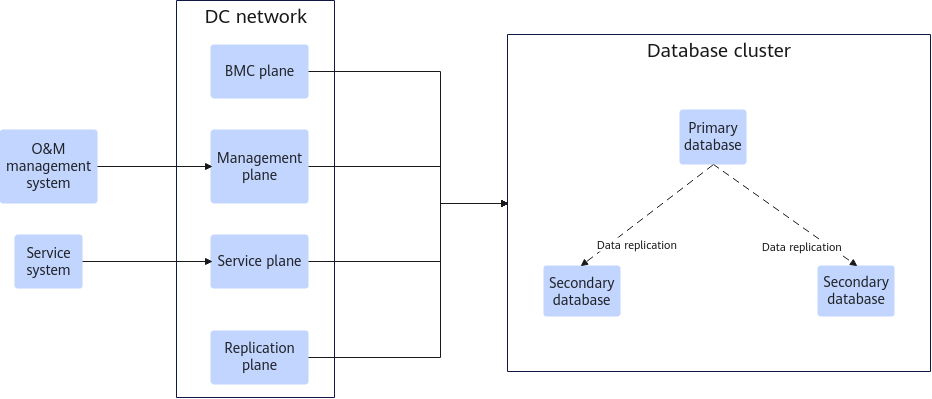
The network plane isolation and link redundancy design meet the requirements of industries such as finance, telecom, and government and enterprise for high reliability, high security, and easy O&M of database systems.