Dynamic Level Capacity Optimization
Application scenario: The traditional LSM-Tree design mainly targets high-throughput write operations, but suffers from low read efficiency, especially for range queries. This feature introduces a new strategy that dynamically adjusts the capacity ratio between adjacent levels to increase the capacity of deeper levels, thereby reducing the number of I/O operations required by queries.
Technical principle:
In a traditional LSM-Tree, the capacity of each level increases by a constant factor T. This optimization introduces an additional scaling factor c (c < 1). The capacity between adjacent levels is calculated using the following formula:

This formula ensures that the amplification factor between the last two levels used by the current dataset is still T; then, as the levels progress toward larger capacities, each level's capacity is obtained by dividing the previous level's capacity by c.
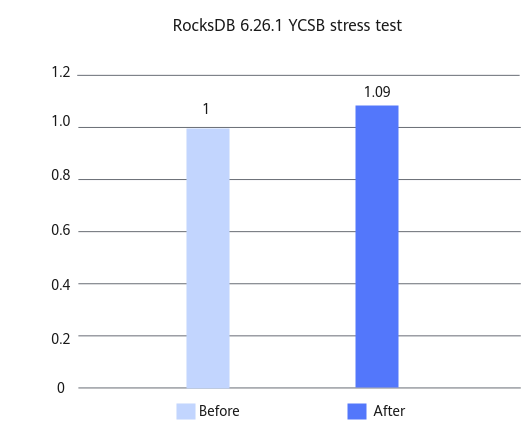
Performance metric: The performance on YCSB workload E is improved by 9%.