Overview
Kunpeng BoostKit is a tool suite for full-stack optimization across Kunpeng hardware, foundational software, and application software, aiming to enable ultimate application performance. It delivers full-stack optimization spanning chips, servers, foundational software, and scenario-specific applications, and focuses on mainstream scenarios such as big data, distributed storage, databases, virtualization, cloud phones, search, recommendation, and advertising (SRA), and Web/CDN. BoostDB is a sub-suite of BoostKit for database scenarios. As a complete Kunpeng-based database solution suite, it provides methods, tools, and practical support for the migration, adaptation, and performance tuning of mainstream open-source and commercial databases, as well as best practices for them. This helps developers efficiently migrate and tune open-source components, forming a complete database solution covering acceleration, migration, and tuning. With a focus on system-level collaborative optimization and acceleration suites for MySQL, Redis, RocksDB, and other databases, it also enables Kunpeng-based database acceleration through full-stack optimization to improve database performance on Kunpeng.
In database scenarios, the booming of Internet services and increase of emerging services cause exponential expansion of data, and the conventional server+storage architecture cannot meet service development requirements. To address such challenges, open-source databases, distributed databases, and cloud-based technologies emerge. More and more enterprises use open-source, distributed, and in-house database technologies to build basic IT database platforms. Currently, new Kunpeng 920 processor models are available in multiple configurations, including 64-core and 80-core variants, while Kunpeng 950 processors offer 64-core, 96-core, and other variants. Kunpeng 950 processors support both single-node and SuperPoD architectures.
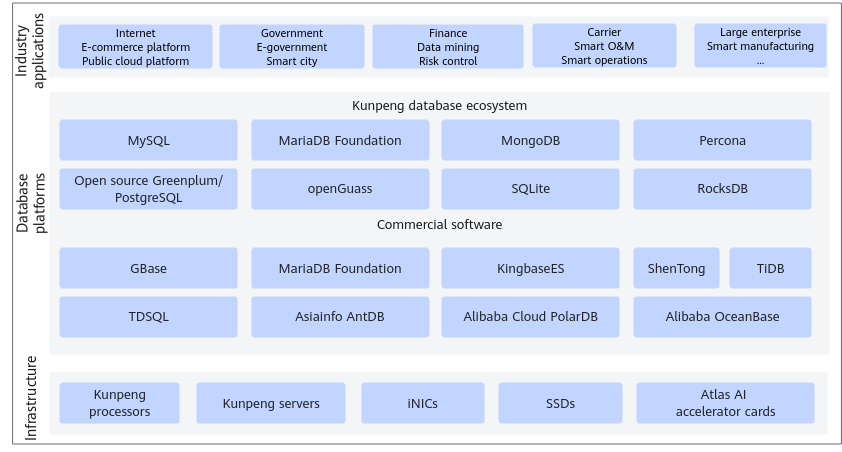
The Kunpeng BoostKit for Database supports open-source databases, such as MySQL, MariaDB, Percona, PostgreSQL, MongoDB, TiDB and China home-built databases, such as GaussDB, GBase, Dameng, KingbaseES, and ShenTong. This solution has distinguished advantages in database real-time analysis, decision-making support, and BI report analysis, and provides a cost-effective general-purpose computing platform for ultra-large databases. Figure 1 shows the architecture of Kunpeng BoostKit for Database.
The solution has the following features:
- Multi-core architecture
The CPU cores can be scaled up to 256, which accelerates database parallel processing and delivers distinguished advantages in online analytical processing (
OLAP ) over x86 servers. - Multiple memory channels
A single socket supports up to 12 memory channels and 24 memory slots, improving memory bandwidth and capacity and accelerating the processing of massive data.
- CPU computing power
The deployment of multiple database instances and virtualization scenarios can fully utilize the computing power of multiple CPUs.
- NVMe SSD
NVMe SSDs deliver hundreds of thousands of I/O operations per second (IOPS), providing higher database performance.