-fconvert-minmax
Description
The minmax and UZP1/UZP2 instructions are optimized to reduce the total instructions and improve performance.
Usage
Use the -fconvert-minmax option to enable the minmax optimization. UZP1/UZP2 instruction optimization is enabled by default at the -O3 or higher optimization level.
Result
The test case is as follows:
1 2 3 4 5 6 7 8 9 10 11 12 13 14 15 16 17 18 19 20 21 22 23 24 25 26 27 28 29 30 31 32 33 34 35 36 37 38 39 40 | typedef unsigned char uint8_t; typedef long int intptr_t; typedef signed short int int16_t; static __attribute__((always_inline)) inline uint8_t clip (int x ) { return ( (x & ~((1 << 8)-1)) ? (-x)>>31 & ((1 << 8)-1) : x ); } void hf (uint8_t *dsth, uint8_t *dstv, uint8_t *dstc, uint8_t *src, intptr_t stride, int width, int height, int16_t *buf) { const int pad = (8 > 9) ? (-10 * ((1 << 8)-1)) : 0; for( int y = 0; y < height; y++ ) { /* This loop is not being vectorized now. */ for( int x = -2; x < width+3; x++ ) { int v = ((src)[x-2*stride] + (src)[x+3*stride] - 5*((src)[x-stride] + (src)[x+2*stride]) + 20*((src)[x] + (src)[x+stride])); dstv[x] = clip ( (v + 16) >> 5 ); buf[x+2] = v + pad; } /* Produces two versions of the code: 3xUZP1/2xMAX/2xMIN + 1xUZP1/1xMAX/1xMIN. */ for( int x = 0; x < width; x++ ) dstc[x] = clip ((((buf+2)[x-2*1] + (buf+2)[x+3*1] - 5*((buf+2)[x-1] + (buf+2)[x+2*1]) + 20*((buf+2)[x] + (buf+2)[x+1])) - 32*pad + 512) >> 10); /* Produces two versions of the code: 1xUZP1/2xMAX/2xMIN + 0xUZP1/1xMAX/1xMIN. */ for( int x = 0; x < width; x++ ) dsth[x] = clip ((((src)[x-2*1] + (src)[x+3*1] - 5*((src)[x-1] + (src)[x+2*1]) + 20*((src)[x] + (src)[x+1])) + 16) >> 5); dsth += stride; dstv += stride; dstc += stride; src += stride; } } |
Test command:
1 | gcc -O3 -fconvert-minmax -S test.c -o test.s |
Figure 1 Option disabled
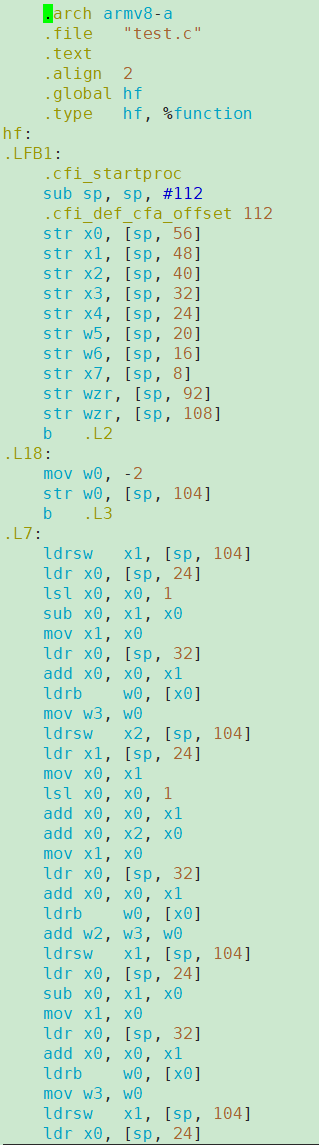
Figure 2 Option enabled
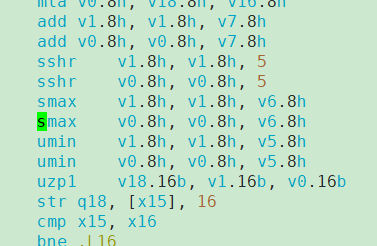
After this option is enabled, the generated assembly code uses the smax, umin, and UZP1 instructions.
Parent topic: Static Compilation Optimization